Kim Eun-hee
🎬 Watch videosToday's Videos
News





![[Event Sketch] Communicating through Drama: Special Lecture by Writer Kim Eun-hee](https://i.ytimg.com/vi/AXgIQCmo5Lk/hqdefault.jpg)



From Signal to Kingdom: Kim Eun-hee, A Genre Unto Herself — The Evolution of Korean Crime Thrillers Through a Writer's Lens
In Korean dramas, it's rare to decide to watch a show based solely on the writer's name, rather than the actors or director. Kim Eun-hee is that rare exception. After gaining recognition with the forensic drama Sign, her themes have varied — from cyber investigations, time-slip thrillers, Joseon zombie historicals, mountain mysteries, to occult stories. Yet, the mere fact that 'Kim Eun-hee wrote it' evokes a certain expectation, a unique texture. This page explores what that texture is, and how it has changed the landscape of Korean crime thrillers, examining her works in chronological order. Broadcasting information covers only confirmed broadcasts as of 2026.
At a Glance
- Who She Is: A drama writer known for Sign, Phantom, Three Days, Signal, Kingdom, Jirisan, and Revenant. Since her debut, she has exclusively written crime, thriller, and genre works.
- Why She Matters: She carved out a niche for 'genre specialists' in a Korean drama market previously dominated by romance, and with Kingdom, she demonstrated early on that Korean genre works could succeed in the international market.
- Two Turning Points: Signal (2016, tvN) is considered the work that redefined the conventions of Korean crime thrillers, while Kingdom (2019-2021, Netflix) marked the beginning of K-genre's global breakthrough.
- Three Key Characteristics: Depiction of professional worlds based on thorough research, a socially conscious perspective that examines the systems behind crimes, and experimental combinations that layer other genres onto crime thrillers.
Filmography
| Year | Title | Broadcast/Platform | Genre Core | One-Line Description |
|---|---|---|---|---|
| 2011 | Sign | SBS | Forensic Investigation | A full-fledged forensic drama centering on forensic scientists from the National Forensic Service. |
| 2012 | Phantom | SBS | Cyber Investigation | A crime thriller prominently featuring the police cyber investigation unit. |
| 2014 | Three Days | SBS | Political Thriller | A thriller that follows a massive conspiracy from the perspective of a presidential bodyguard. |
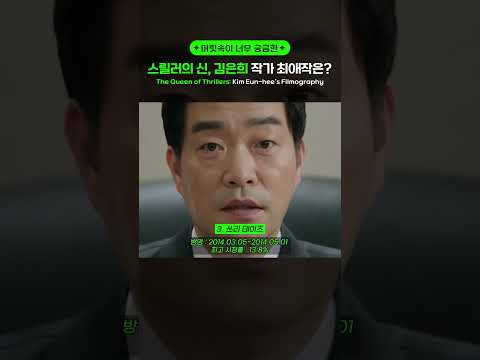
| 2016 | Signal | tvN | Time-Slip Investigation | Past and present detectives communicate via a walkie-talkie to pursue cold cases. |
| 2019~2021 | Kingdom Season 1 & 2, Ashin of the North | Netflix | Joseon Zombie Historical | A historical thriller that layers the spread of a plague (zombies) with power struggles. |
| 2021 | Jirisan | tvN | Mountain Mystery | Rangers of Jirisan National Park investigate the truth behind mysterious deaths occurring on the mountain. |
| 2023 | Revenant | SBS | Occult Mystery | An occult work combining Korean folklore and crime investigation. |
She debuted in drama with KBS's Harvest Villa in 2010, having started her writing career with film screenplays before that. As seen in the table, her filmography, which has never deviated into melodrama since her debut, is exceptional in the Korean drama market.
Three Pillars of Kim Eun-hee's Narrative Style
First, the world of a profession forms the backbone of the story. From forensic scientists (Sign) and cyber investigation units (Phantom) to profilers and detectives (Signal), mountain rangers (Jirisan), and folklorists (Revenant) — the protagonists in Kim Eun-hee's dramas are always 'working professionals'. Details like autopsy procedures, radio communication, and mountain rescue operations are not mere embellishments but serve as actual keys to solving cases. This exemplifies how research-based writing creates the persuasiveness of genre works.
Second, she places the system behind the incident. In Kim Eun-hee's dramas, catching the culprit is not the end. The real questions are: Why did the case remain unsolved? Who covered up the investigation? How did the system fail the victims? Signal's direct confrontation with the statute of limitations issue is a prime example. It aired shortly after the 'Taewan's Law', which abolished the statute of limitations for murder, was passed in 2015. The drama dramatized the gravity of cold cases based on that social discussion.
Third, she layers genres. She adds time-slip elements to crime thrillers (Signal), zombies to historical dramas (Kingdom), and folklore and occult elements to investigations (Revenant). What's important is not the combination itself, but its direction. These unusual devices always serve as 'lenses to re-examine certain issues within Korean society'. That's why Kingdom, a zombie story, is ultimately about hunger and power.
Signal — A Turning Point for Korean Crime Thrillers
Signal (2016) tells the story of past detective Lee Jae-han (Jo Jin-woong) and present profiler Park Hae-young (Lee Je-hoon) communicating via an old walkie-talkie to pursue cold cases together. With detective Cha Soo-hyun (Kim Hye-soo) connecting the two timelines, the intertwining of the three characters' times gradually alters the events.
The cases in the drama were inspired by real-life cold cases. A prime example is the episode inspired by the Hwaseong serial murders, which led to the drama being re-discussed in 2019 when the real culprit of the actual case was identified years later. It's a rare instance where fiction made people remember a real-life cold case, and reality, in turn, recalled the fiction.
Signal is a turning point for three reasons. It proved that genre works on cable channels could achieve both buzz and high quality simultaneously, shifted the focus of crime thrillers from 'the thrill of catching the culprit' to 'remembering the victims who were failed', and established the emotional standard — people over cases, mourning over tricks — that Korean crime thrillers would subsequently follow.
Kingdom — Unleashing Zombies in Joseon
Kingdom originated from the manhwa Land of the Gods, for which Kim Eun-hee wrote the story. Amidst rumors that the king is afflicted with a mysterious illness, Crown Prince Lee Chang (Ju Ji-hoon) pursues the truth behind the plague, physician Seo-bi (Bae Doo-na) delves into the nature of the disease, and powerful minister Cho Hak-ju (Ryu Seung-ryong) even uses the plague as a tool to maintain his power.
Season 1, released in 2019, was Netflix's first original Korean series. The combination of the unfamiliar Joseon setting and the familiar zombie genre resonated perfectly with international viewers. The fact that Joseon-era hats, including the gat (traditional Korean hat), became a hot topic among international viewers was a symbolic moment, showing that Korean cultural details could be a competitive advantage rather than a weakness for genre works. Following Season 2 (2020), a special episode titled Kingdom: Ashin of the North (starring Jeon Ji-hyun), which delves into the backstory of Ashin, a character who appeared at the end of Season 2, was released in 2021.
The zombies in Kingdom are not just simple monsters. As seen in the premise where starving commoners become monsters after eating human flesh porridge, the plague symbolizes hunger, and the responsibility for the disaster always lies with the incompetence and greed of those in power. The 'perspective of seeing the system behind the incident', honed in her crime thrillers, functioned perfectly even within a historical zombie drama.
An Evolutionary Path: From Sign to Revenant
Kim Eun-hee's filmography almost perfectly mirrors the evolution of the Korean genre market.
- Terrestrial Broadcast Era (2011-2014): Sign, Phantom, and Three Days all aired on SBS. This period saw her push professional crime thrillers within terrestrial broadcast schedules, which typically favored romance. She brought professional worlds like forensics and cyber investigation, rarely explored in Korean dramas at the time, to the forefront.
- Cable Shift (2016): Signal's move to tvN coincided with a trend allowing genre works to break free from terrestrial broadcasting norms and experiment with darker tones and tighter narratives.
- OTT Expansion (2019-): Kingdom demonstrated the extent to which a Korean writer's vision could thrive on global platforms with fewer restrictions on episode count, intensity, and runtime.
- Deepening into Korean Themes (2021-): Jirisan delved into the space of the mountain, while Revenant explored folk beliefs and shamanism. In particular, Revenant (2023), centered around Gu San-young (Kim Tae-ri), possessed by a demon, and folklorist Yeom Hae-sang (Oh Jung-se), who sees spirits, addressed the contemporary theme of youth despair through occult narrative.
This trajectory also represents the evolution of Korean crime thrillers as a whole. From 2000s-era crime dramas where detectives also had romances, to genre works with professionalism and social inquiry, and then to K-genre works competing in the global market. A culture where a writer's name becomes a brand that drives viewership also took root during this process. The background of such 'writer-centric viewing' is discussed more broadly on the Drama Writers page.
How to Watch — A Step-by-Step Guide
- Step 1: Start with Signal. This work embodies the essence of Kim Eun-hee's narrative style, and even those who don't typically enjoy genre works can follow the emotional arcs of the characters. As a 16-episode mini-series, it's also less daunting.
- Step 2: Kingdom Seasons 1 & 2. Each season is short and highly condensed with 6 episodes. Even if you're new to zombie stories, it's not difficult to get into if you view it as a historical political drama.
- Step 3: Branch out according to your taste.
- If you're curious about Kingdom's world → Kingdom: Ashin of the North
- If you enjoyed authentic professional crime thrillers → Sign, Phantom
- If occult and mystery are more your style → Revenant
- If you prefer a slow-burn mystery with a natural backdrop → Jirisan
- Step 4: Revisit Signal. After watching her other works, you'll interpret the social contexts and foreshadowing you might have missed during your first viewing differently.
Checklist: Is it a Kim Eun-hee Drama?
These are the characteristics you can check when a drama is described as 'Kim Eun-hee-esque'.
- [ ] Is the protagonist introduced first as a 'professional' rather than a romantic interest?
- [ ] Does the story continue even after the culprit is caught — with questions about those who covered up or the institutions that condoned?
- [ ] Are there scenes that re-examine the case from the perspective of the victims and their families?
- [ ] If there is romance, does it remain in the background rather than driving the narrative?
- [ ] Are two or more different genres layered, and is their combination used as a device to highlight social themes?
If four or more of these items apply, then the work stands within the trend created by Kim Eun-hee.
FAQ
Are Kim Eun-hee and Kim Eun-sook the same person?
No, they are different people. While often confused, Kim Eun-sook is the writer behind works like Guardian: The Lonely and Great God, Mr. Sunshine, and The Glory, known for romance and revenge dramas. Kim Eun-hee, on the other hand, specializes exclusively in crime, thriller, and genre works. They do share the commonality of being writers whose names have become a brand.
Is Kingdom based on an original work?
Its starting point is the manhwa Land of the Gods, for which Kim Eun-hee directly wrote the story. It's not an adaptation of an external original work but an expansion of the writer's own story into a drama, so there are differences in the settings and developments between the manhwa and the drama.
Is Signal a true story?
It is not a true story itself, but a work of fiction inspired by real-life cold cases. The episode motivated by the Hwaseong serial murders is a prime example, while the premise of communicating with the past via a walkie-talkie is entirely fictional.
Is Kingdom: Ashin of the North a must-watch?
It's a special episode that covers the past of Ashin, a character who appeared at the end of Season 2. It's natural to watch it after Seasons 1 and 2, and while not essential for understanding the main story's conclusion, it expands on the northern backdrop of the world and the origins of the plague.
Can someone who doesn't typically watch crime thrillers get into her works?
Yes, it's possible. Kim Eun-hee's dramas prioritize character emotions and social questions over brutal tricks, making them less intimidating for viewers who find the typical coldness of crime thrillers off-putting. For an introductory work, we recommend Signal, as per the step-by-step guide above. If you're generally curious about choosing dramas based on writers, you can continue reading on the Drama Writers page.
Recommended Videos
News


![[Son Seok-hee's Questions] Korean Dramas Are Divided into Before and After Kim Eun-hee (feat. Jang Hang-jun) MBC 250401 Broadcast](https://i.ytimg.com/vi/DKTyK9_unPE/hqdefault.jpg)
![[Sohn Suk-hee's Questions] Kim Eun-sook and Kim Eun-hee's trade secrets that captivate viewers?! MBC 250401 Broadcast](https://i.ytimg.com/vi/CieNJTnjseM/hqdefault.jpg)
![[Son Seok-hee's Questions] Reality that feels more like a fictional situation than a drama, Korean society as seen by Kim Eun-hee and Kim Eun-sook, MBC 250401 Broadcast](https://i.ytimg.com/vi/WVffva83M5M/hqdefault.jpg)